Japanese Anime Art Book Girls Playing on the Beach
Body of water Waves (海がきこえる , Umi ga Kikoeru , lit. "I Can Hear the Sea") is an anime television picture show directed by Tomomi Mochizuki and written by Kaori Nakamura. Information technology was animated by Studio Ghibli for Tokuma Shoten and the Japan Idiot box Network and premiered every bit office of the network's 40th ceremony on May 5, 1993. After being broadcast on NTV, information technology was aired on several NTV affiliates.
It is based on the same-named novel by Saeko Himuro. Fix in Tosa and Kōchi (metropolis) in Shikoku, it concerns a love triangle that develops between two good friends and a new girl who transfers to their loftier school from Tokyo. It was produced every bit part of the Nihon Arts Quango Grant Program and was an attempt by Studio Ghibli to let their younger staff members to brand a moving picture reasonably cheaply following the release of Porco Rosso. Nevertheless, it ended up going both over budget and over schedule.
Information technology won the Encouragement Award at the 31st (1993) Galaxy Award (Nippon). In December 2016, GKIDS remastered the film for a limited theatrical release, with a home video release in Spring 2017.
Its poster'southward catchphrase is, "Kochi / Summer / 17-year-old me and Satoko's prologue." (高知・夏・17歳 僕と里伽子のプロローグ。)
The original novel was followed past a sequel, I Tin can Hear the Sea 2: Because There Is An Center (海がきこえるII〜アイがあるから〜 , Umi ga Kikoeru Two Ai ga Arukara) written by Saeko Himuro and published by Tokuma Shoten on Apr i, 1995.
Contents
- 1 Overview
- 2 Plot
- three Characters
- 3.1 Supporting Characters
- 4 Behind the Scenes
- 4.1 Planning
- 4.2 Production
- 4.iii Dubbing
- v Reception
- 6 Distribution
- 7 Music
- eight Locations
- eight.1 Kōchi
- 8.ii Tokyo
- nine Credits
- 10 References
- 11 External Links
Overview
The picture is based on a novel by Saeko Himuro, which was serialized 23 times in Tokuma Shoten's Animage magazine from February 1990 to January 1992 and later published as a book. Katsuya Kondō, grapheme designer and animation managing director of Kiki's Delivery Service (1989), provided character illustrations based Himuro's notes, and Himuro himself was inspired past Kondō's illustrations. The novels were adequately popular among the youth at the time, thanks to how information technology depicted a feeling of nostalgia in its story.
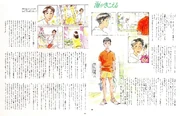
I Tin can Hear the Sea serialized on Animage magazine. Pages from the July 1990 issue with illustrations by Katsuya Kondō.
The reason why it was serialized on an anime magazine was that the editorial department of Animage wanted to "publish the work of a major non-anime writer." Sanae Mitsugi, the editor of Tokuma Shoten, commissioned writer Saeko Himuro to write a book and with visuals provided by Studio Ghibli. At that time, Himuro was a popular writer of Chiyoda-based publisher Shueisha and a leading figure in the paperback characterization Cobalt Bunko for girls. Himuro was skeptical of taking the job, but Mitsugi convinced him by saying that Ghibli would be involved. In July 1989, Himuro was invited to the premiere of Kiki's Delivery Service and decided he "wanted to write an catastrophe similar to this movie.".
The serialized chapters were compiled into a volume in 1993, edited past Himuro himself with some capacity omitted. In the aforementioned twelvemonth, Studio Ghibli was developing a television film project with character designs by Kondo.
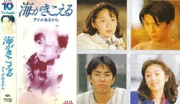
The Sea Waves live-activeness adaptation aired in 1995.
In April 1, 1995, the sequel, I Can Hear the Sea II: Because There Is An Center was published, with Katsuya Kondō providing illustrations once once more. In Dec 1995, saw a TV drama based was also released, starring Shinji Takeda.[1]
In 1999, I Tin can Hear the Sea and I Tin Hear the Sea Ii: Because There Is An Eye were compiled into a single paperback book published by Tokuma Bunko. This latest edition was updated to account for the passage of time, thus minor corrections were made such every bit what hit songs appeared in the novel (such as "Wink" by Namie Amuro). Shinji Miyadai, a sociologist, provided commentary for this new paperback edition, and Yoshikazu Okada, the scriptwriter for the TV alive-activity drama version, was in charge of its sequel.
Plot
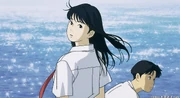
Taku Morisaki falls for the new transfer student Rikako Muto.
At Kichijōji Station, Tokyo, Taku Morisaki glimpses a familiar woman on the platform opposite. Later, every bit his flight to Kōchi Prefecture takes off, he narrates the events that brought her into his life. The story is told in flashback.
In Kōchi, two years prior, Taku receives a phone call from his friend, Yutaka Matsuno, asking to encounter at their high schoolhouse. He finds Yutaka at a window, watching an attractive female transfer educatee whom Yutaka was asked to testify around. The boys discuss their upcoming school trip to Hawaii. At the school gates, Taku is introduced to the new girl, Rikako Muto. She thanks Yutaka for providing directions to a bookstore. Taku teases Yutaka about his infatuation.
Rikako is academically gifted and good at sports, but too arrogant. Taku believes she is unhappy virtually leaving Tokyo. His mother learns from gossip that a divorce brought Rikako'due south mother to Kōchi. In a telephone conversation with Yutaka, he discovers that Rikako is living abroad from the family house.
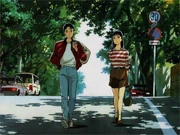
Tension arises betwixt Taku and Rikako.
The schoolhouse yr ends, heralding the Hawaii trip. Taku, suffering from an upset stomach, is stopped in the hotel antechamber by Rikako. She explains that she has lost her money and asks to borrow some. As Taku has a part-time job, he lends her ¥60,000. Promising to repay him, she warns not to tell anyone. As she departs, Taku sees a stern Yutaka and feels compelled to explicate. Later, Rikako admonishes him for telling Yutaka about the money, saying that he also loaned her ¥twenty,000.
Back in Kōchi, the tertiary year begins with Rikako making a friend, Yumi Kohama. Rikako hasn't returned Taku's money and he wonders if she has forgotten. Out of the blueish, a distressed Yumi calls Taku, explaining that Rikako had tricked her into coming to the airport on the pretence of a concert trip, only to notice that their real destination is Tokyo, tickets paid for with Taku'south money. He races to the airport, sending Yumi dwelling, proverb that he will accompany Rikako.
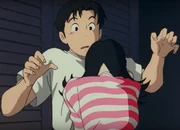
Rikako seeks Taku for comfort afterward beingness betrayed past her father.
Upon arrival, it appears that Rikako has non forewarned her male parent, interrupting his planned trip with a girlfriend. Her male parent thank you Taku, repays the loan and arranges a room at the Hyatt Regency hotel. Later on, Rikako explains that when her parents were fighting, she'd ever sided with her father, but had now discovered he wasn't on her side. Comforting her, Taku offers his bed and attempts to sleep in the bathtub. The next morning, Rikako seems back to her normal self and kicks Taku out so that she can alter clothes to meet a friend for lunch. Taku wanders effectually the city. Afterwards catching up on sleep at the hotel, Taku receives a telephone call from Rikako asking to be rescued from former young man, Okada, who is not every bit she remembered him.
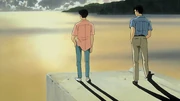
Taku reminisces with Yutaka Matsuno about loftier school.
Returning abode, Rikako ignores Taku, simply doesn't hide from others that they spent a night together. Taku discovers this from Yutaka, who had earlier confronted Rikako to confess his feelings toward her, merely had been rebuffed. Taku confronts Rikako in form for hurting his best friend, calling her "The worst!". She responds by slapping him and he slaps her in return.
The fall school cultural festival arrives and Rikako, who has been avoiding Yosakoi trip the light fantastic rehearsals, becomes more than distant from the other girls, many of whom openly dislike her. Confronting her behind the schoolhouse, Rikako stands firm every bit ane daughter, assertive that Rikako was flirting with her boyfriend, attempts to strike her but is held dorsum. Taku, who has seen all, approaches Rikako and comments that he is impressed with the way she handled herself. She slaps him. Yutaka confronts a somewhat stunned Taku, who tries to explicate. Yutaka punches him to the basis and walks away. They do not talk for the residual of the year.
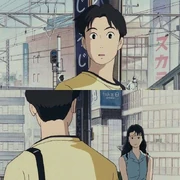
Taku recognizes Rikako while continuing on a railroad train platform several years subsequently.
In the present, Taku'south airplane lands and he is offered a lift habitation by Yutaka, who explains he punched him because he'd realized Taku had held dorsum his feelings for his sake. At a class reunion, former student president Shimizu mentions she had met Rikako earlier. She explains that equally Rikako was attending Kōchi University, she had flown to Tokyo for her school break, missing the reunion. Taku realizes that Rikako was the woman he'd seen at the station. Walking habitation, Yumi tells Taku that she too had met Rikako, explaining she couldn't make it to the reunion and that she wanted to run into someone, but wouldn't say who... just that he slept in bathtubs.
In Tokyo, Taku again sees Rikako across the platforms, merely this time runs to find her. As the train pulls abroad, he finds Rikako and realizes that he had e'er been in honey with her.
Characters
- Taku Morisaki (杜崎 拓 , Morisaki Taku)
- Nobuo Tobita
- Master protagonist. Taku, needing money for the schoolhouse's trip to Hawaii, took his restaurant busboy job to offset the expense, at the cost of falling grades and his teachers' disapproval. He can exist blunt to the point of tactlessness. After graduating from high schoolhouse, he went on to a university in Tokyo and stayed in an apartment near Shakujii Park (石神井公園, Shakujii Kōen). His parents' live in Mt. Godai, Kōchi Urban center
- Rikako Muto (武藤 里伽子 , Muto Rikako)
- Yōko Sakamoto
- The heroine. Due to familial bug, Rikako moved from Tokyo to Kōchi to be with her mother's parents. She's a pretty second-twelvemonth high schooler (eleventh grader) with an excellent bookish record and is active in sports, but is not good at socializing. She hardly participates in class activities and has only 1 friend, Yumi Kohama. Later on graduating from high school, she took the entrance exam for Kōchi Academy and passed, just she as well secretly took the archway examination for a women's college in Tokyo and attended that instead.
- Yutaka Matsuno (松野 豊 , Matsuno Yutaka)
- Toshihiko Seki
- Taku'south friend and rival for Rikako's affections. Yutaka and Taku became friends when they jointly campaigned against the counterfoil of their junior high school trip due to the school's depression exam scores. After graduating from high school, he enrolled at Kyoto University ( "National University of Kyoto" in the anime).
Supporting Characters
- Yumi Kohama (小浜 裕実 , Kohama Yumi)
- Kae Araki
- Rikako's closest friend in Kōchi. When Yumi changed classes in tertiary-year in high school (6th class), she sat beside Rikako and the ii became fast friends. She always had the impression that Rikako was the "queen" while she was a "handmaiden". After graduating from high school, she went on to a women's college in Kobe. She later confessed, "I feel similar I was being used by Rikako."
- Akiko Shimizu (清水 明子 , Shimizu Akiko)
- Yuri Amano
- Female student-body president. Taku'due south high schoolhouse classmate, whom he calls a typical "class president type". She leads several girls to confront Rikako. She despised Rikako, but those feelings subsided later graduating from high school. She happened to meet Rikako during her summer holiday in Kōchi.
- Okada (岡田 , Okada)
- Jun'ichi Kanemaru
- Rikako's ex-fellow. While in Tokyo, Rikako heads to a restaurant in the hotel to see with Okada. Over the course of the meal she discovers that he is not the type of person she one time thought he was. He has also started dating Rikako's best friend. During the meal, Rikako telephones Taku to ask him to rescue her from the situation. When Taku met him, he thought Okada was really handsome.
- Tadashi Yamao (山尾 直 , Yamao Tadashi)
- Hikaru Midorikawa
- Taku's large friend, who has a vanquish on Yumi. He confesses this dear to anybody at the class reunion prior to Yumi's arrival, before collapsing into unconsciousness due to excess alcohol consumption.
Backside the Scenes
Planning
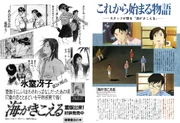
I Tin can Hear the Sea promotion on Animage's June 1993 issue.
The get-go discussions apropos the process of adapting Saeko Himuro'southward novel I Can Hear the Sea into animation took place in June 1992, when Porco Rosso was existence dubbed. Hayao Miyazaki, who could non think of an idea for his next pic project, felt the younger staff trained in Takahata's Merely Yesterday and Porco Rosso needed to take charge of this new production.
Himuro's novel was kickoff serialized in October 1989 andpublished on the February 1990 issue of Animage mag (owned by Studio Ghibli's parent company Tokuma Shoten, with illustrations by Katsuya Kondō. The monthly instalments were collected in a hard cover book published in Feb 1993. The novel, which targeted adolescents, seemed in line with the young generation of creators who would be ameliorate able to place the kickoff feelings of love of this age of life on the screen.
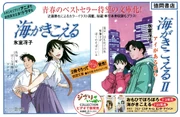
Promotional ad for the original novel and its sequel on the July 1999 issue of Animage.
Kondō, having worked on the novel, served as the character designer and blitheness director for the adaptation. The studio requested Kondô work on the film's production while the novel was however being published in Animage.
Suzuki turned to Tomomi Mochizuki, who was 34 years erstwhile at the time, to direct due to his experience working on Creamy Mami, the Magic Angel (1983) Maison Ikkoku (1986) and Kimagure Orange Road (1987), all of which were serial that dealt with adolescence. At the time, Mochizuki was already fan of Himuro's work and had been wanting to arrange one of his novels into blitheness.
Production
Katsuya Kondō was responsible for the original novel's illustration and character design for the film.
Production of Bounding main Waves was controlled by Studio Ghibli, but much of the animation was produced with the assistance of J.C. Staff, Madhouse Studios, and Oh! Production, who had worked with Ghibli on by projects. This moving-picture show is the commencement Ghibli anime meant for idiot box and directed by someone other than Hayao Miyazaki or Isao Takahata. Additionally, this is the outset work produced at Studio Ghibli's new role building at Higashi-Koganei.
The motto for the product of the Television receiver movie was "fast, cheap and of high quality". For his role as director, Mochizuki paid detail attention to the realism of the characters. The character clarification was the nearly of import point for him, his favorite character being Rikako. Meanwhile, background creative person Kazuo Oga and Art Director Naoya Tanaka stepped in to oversee the young staff.
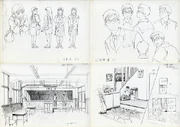
Diverse pre-production character and background sketches for the moving-picture show.
The director wondered if the film would have been better off washed in live-activity rather than blitheness. For example, in a scene where there are merely ii characters played by actors chatting, the viewer can easily follow their state of mind on their faces. Transcribing this state of listen in animation requires a lot of work and precision on the part of the animators and is more than hard.
But the reward of animation over actual shooting is that the audience can identify with the characters and their feelings more easily, with the simplification of facial features, more anonymous, helping. Animation is all the more an advantage when dealing with such a delicate subject of love, which tin hands plunge the viewer into embarrassment with real actors.[ii]
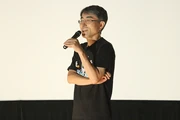
Tomomi Mochizuki suffered health problems after simultaneously working on Sea Waves and Here Is Greenwood.
In the end, the production schedule and budget went far across what was had been initially planned. Production began on September 24, 1992, but while Studio Ghibli wanted all the drawings to be completed by the cease of 1992, they were finally completed in February 1993 and the TV film, meanwhile, would not exist fix until March eighteen. 1993. Numerous changes had to exist fabricated from its original source novel, as several capacity were left out past the manager. They had to determine how much time would be spent with the characters while they were high school versus at the university.
As a issue of several discussions with Animation manager Kondo, product producer Nozomu Takahashi, and scriptwriter Kaori Nakamura, the story was mainly focused in high school. This resulted in the narrative cutting back and forth betwixt the past and the present. The graphic symbol's interim and emotional expression were likewise intentionally subdued compared to other Ghibli works. To ease the brunt for the animation team, Kondo drew a second storyboard with more a detailed layout every bit reference. In addition, photos taken during location scouting were enlarged and copied to be used as background images for several shots to simplify the background work.
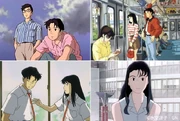
The product faced challenges early on equally the majority of teenage tv anime at the time were based on scientific discipline fiction.
Despite beingness fabricated for television, the film was made in xvi:9 aspect ratio, versus the four:iii which was the norm at the time. The production side recognized the film as a "picture" and not a telly special.
Mochizuki, who had been working on Here Is Greenwood at the same time as this production, developed Peptic ulcer because of stress. By the end of Oct 1992, he collapsed due to anemia and bleeding and was hospitalized. He returned to Ghibli's offices to celebrate the completed production later on being on an intravenous drip at the infirmary. Production began on August 11, 1992, and ended on April 10, 1993, and roughly 25,530 drawings were produced.
Whisper of the Heart, which was written and produced by Hayao Miyazaki and released in 1995, was inspired by Ocean Waves. In addition, Yoshifumi Kondō, the director of Whisper of the Heart, animated a dining scene at Taku Morisaki'south business firm in showtime of Body of water Waves.
Dubbing
Casting for majority of the cast was decided via record auditions sent past veteran voice actors. But the role of Satoko and Yoko Sakamoto, who was separately active in a small theater company, were selected by a dissimilar method. Amongst all other Studio Ghibli works, this is the only production where a male person full-time phonation actor (Nobuo Tobita) plays the phonation of the primary character. It is unusual for a Ghibli piece of work to be voice by total-time voice actors.
Among the participating voice actors, Sumi Shimamoto and Takeshi Watabe from Kochi Prefecture served as dialect teachers.
It is the just Ghibli moving picture that does not accept an English dub, as But Yesterday didn't have a dub until 2016.
Reception
The website Animé Café gave the moving picture 4/five stars, noting this to be "A svelte and mature offering from Ghibli's younger generation".
Otaku Us gave the film a mediocre review. kVin from the Sakuga Web log noted that this early attempt by Studio Ghibli at finding a successor for the studio concluded in failure. "Much like other renowned directors similar Mamoru Hosoda and Hiromasa Yonebayashi, Tomomi Mochizuki failed to go the successor to the titans who founded the studio." Although the writer did not that even Takahata struggled living up to the Ghibli name. "In the end I would argue that Ghibli's brand asphyxiated even Takahata, whose works were heavily penalized in the box office by his desire to devious away from their established identity, then I wouldn't blame anyone for failing to sit on a throne that had become Hayao Miyazaki's alone."
"This isn't to say Mochizuki'due south work was without fault, of class. The movie is absolutely clumsy, starting from the patchwork narrative framing device that struggled to cover both past and present fifty-fifty after a sizable length increase. The management of the project in general didn't fare much improve; what was intended equally a cheaper, quick Goggle box project concluded up costing well beyond expectations, and for all their intent to requite Ghibli'south own youth the chief role, they had to rely on other studios to salve the production from doom. The stress piled upward to the point that Mochizuki himself passed out, while he tried juggle his responsibilities with other productions he'd accepted beforehand. But the fact that he enjoys reminiscing nearly the project, including detailed retellings of the incident that sent him to the hospital, proves it was in its own manner a worthwhile experience."[3]
The review aggregator website Rotten Tomatoes gave it a rating of 87%, based on 15 critical reviews, with an average score of 6/10. On some other aggregator Metacritic, it has a score of 73 out of 100, based on four critics, indicating "generally favorable reviews".
Distribution
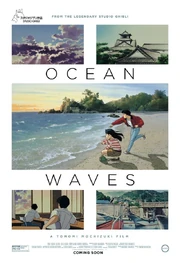
GKIDS's poster for the picture show's remastered theatrical re-release in 2016.
Disney originally had the rights of distribution of Ocean Waves in U.s.a.. merely they never released the film onto whatsoever Home Media platform. In 2016, GKIDS announced that they are going to release Ocean Waves in North American theaters starting on Dec 28 of that yr and expanding during early 2017. In 2008, distribution company Wild Bunch appear that information technology had licensed the film to a number of European releasing companies, including Optimum. Information technology was released in the UK nether the title Ocean Waves on January 25, 2010, presently before the planned theatrical release of Ponyo, every bit part of the Studio Ghibli Collection. As with the film But Yesterday (until 2016), it was released with subtitles only.
In Spain, the motion picture is distributed past Aurum and was released on DVD in November 2008. The DVD includes Japanese and Castilian audio tracks and Spanish subtitles. It was titled equally Puedo escuchar el mar (in English language translation I Can Hear the Sea).
In Australia, the pic is distributed by Madman Entertainment every bit a subtitle-only DVD.
A Blu-ray remastered version was released on July 17, 2015, in Japan past Walt Disney Studios Japan.
In December 2016, GKIDS announced that the film will be remastered for a limited theatrical release, offset on December 28, 2016, with a dwelling video release in Spring 2017.
Music
Ocean Waves (Original Soundtrack) (海がきこえる ,Umi ga Kikoeru) was first released by Animage Records and Tokuma Nihon Communications on May 1, 1993, and re-issued on April 21, 1997. The soundtrack, composed by Shigeru Nagata and features performances by Yoko Sakamoto, is in the tone of the TV moving picture, that is to say at-home and soothing. The pieces, well-nigh often on the pianoforte, alternate between comic and seriousness, enthusiasm and sadness. Some are harmless, others play more on the emotions. Every bit with the film, the whole is coherent and balanced.
Locations
Kōchi
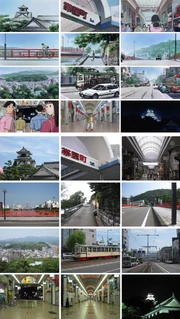
Sea Waves is ready in Kōchi and Tokyo, and some scenes are based on photographs taken from location scounting. Seen hither is a comparing between the film and its real-life analogue.
Unless otherwise specified, all are situated in Kōchi city.
- High School The loftier schoolhouse that Taku and his friends appear in the original is modeled afterwards Kōchi's private Tosa High School, but the advent of the anime schoolhouse building is modeled after Kōchi Tano High School.
- Tenjin Ohashi The bridge that Taku crosses afterward Matsuno calls him from school. It spans the Kagami River. The proper name of the bridge is derived from Ushioetenmangu, which is located in the southwest.
- Obiyamachi An arcade town in Kōchi City that oftentimes appeared in anime. It is also the primary road of the Yosakoi Festival .
- Godaiyama The surface area where Taku's parents' abode is located. The Gokoku Shrine and Chikurinji Temple are nearby.
- Kōchi Castle In the original novel, Taku and Satoko wait up at Kōchi Castle, and in the anime, Taku and his friends are drunkard.
- Kōchi Airport (Nankoku City): The drome used by Taku and Satoko when they left for Tokyo. Also where Taku is reunited with Matsuno after returning home. The circular sofa was removed in June 2002, and the airdrome proper noun was nicknamed "Kōchi Ryoma Airport" in November 2003.
- Kure Port (Takaoka-gun Nakatosa Kure) Just appears in the anime. The identify where Taku and Matsuno relax subsequently they reunite at Kōchi Airdrome and before their reunion with other loftier-school alumni. In fact, the tip of the embankment wants the mountain side, and the setting sun is setting on that mountain side.
- Shin-Aoyagi Span In the anime, Taku and his friends cross if from the embankment of Kure Port, but it is actually located in the Godaisan area.
- Shimanto River (Shimanto City, etc.) In the Animage serialized version, Taku and Satoko, Matsuno and Chisa swim, and in the live-activity drama, Taku and Satoko, Tasaka and Chisa play in the river and have a date at the Katsuma subsidence bridge over the river.
- Katsurahama Information technology appeared frequently in various parts of the drama, and the last scene was also shot in Katsurahama. All five main characters of the drama visited.
Tokyo
- Shakujii Park (Nerima Ward) After Taku enters academy, the apartment he was staying at is located near the park. The original edifice has since been demolished. Appeared in the original and the anime.
- Haneda Airport (Ota Ward) An empty gateway that Taku used when he returned to Kōchi to attend the alumni meet-up and when Taku and Satoko traveled to Tokyo. The new domestic terminal edifice (1st passenger terminal edifice) was completed in September 1993 afterward the anime was circulate. In December 2004, the sometime Haneda Airport building was completely removed.
- Hamamatsucho Station (Minato Ward):A connecting station betwixt the Tokyo Monorail and the JR Yamanote Line .
- Seijo (Setagaya Ward) The town where Satoko originally lived. Immediately later on leaving the n go out, there is an existing condominium where Satoko's father lives.
- Seijo Gakuenmae Station (Setagaya Ward): The station where Taku and Satoko become off when they went to the apartment where Satoko's father lived. At the fourth dimension of the anime's broadcast, information technology was known as the Hashigami station edifice, just from March to June 2002, both the upper and lower lines were relocated secret, and the remnants of that time are completely gone.
- Hotel Century Hyatt Tokyo (currently Hyatt Regency Tokyo) (Shinjuku Ward): In the anime, the hotel where Taku and Satoko stayed in Tokyo. On the outset floor, there was a tea room called Boulogne, which was modeled on the anime, just since then, was completely renovated equally COFFE in April 2009.
- Kichijoji Station (Musashino City) Appears only at the beginning and terminate of the anime. The station where Taku reunited with Satoko. Taku was at homes 1 and 2, and Satoko was at homes iii and 4. Due to the improvement piece of work carried out for about four years from March 2010, the vestiges of that time have now faded.The station building "Kichijoji Ronron since its opening as well", for the first time total-scale renovation, 2010, April 1, in the "Atre was reopened as Kichijoji"
Credits
| Credit | Staff |
|---|---|
| Manager | Tomomi Mochizuki |
| Screenplay | Keiko Niwa |
| Character Pattern, Animation Director | Katsuya Kondō |
| Key Animation | Atsuko Otani, Hideaki Yoshio, Hiroomi Yamakawa, Hiroshi Shimizu, Katsuichi Nakayama, Kenichi Konishi, Kenichi Yoshida, Masaaki Endou, Masako Shinohara, Masashi Ando, Mayumi Hirota, Mitsuo Iso, Noriko Moritomo, Shougo Furuya, Takao Yoshino, Takeshi Inamura, Toshio Kawaguchi, Yoshifumi Kondō |
| In-between Blitheness | Akihiko Adachi, Akiko Matsushima, Akiko Teshima, Emiko Iwayanagi, Eriko Shibata, Hiroyuki Inoue, Hisako Matsuda, Katsutoshi Nakamura, Kazuko Shibata, Kazumi Yokoyama, Kazuyoshi Onoda, Kenichi Yamada, Kiyoko Makita, Kumi Horii, Kumiko Ohta, Masako Sakano, Masaru Matsuse, Masaya Saito, Mayumi Ohmura, Michiko Okada, Nobuko Sato, Reiko Mano, Ritsuko Shiina, Seiko Azuma, Shinsaku Sasaki, Takehiro Noda, Tsuyoshi Konakawa, Yōko Nagashima, Yukari Yamaura, Yumiko Kitajima |
| Paint | Chiyomi Morisawa (Studio Killy), Fumie Mukai (Studio Killy), Kanako Moriya, Masayo Iseki, Naomi Mori, Noriko Ogawa, Teruyo Tateyama, Tokiko Yoshida (Studio Killy), Tomomi Nakazato (Studio Killy), Tsunetaka Arai (Studio Killy), Yukie Kitsukezawa, Yuriko Kudo (Studio Killy), |
| Fine art Director | Naoya Tanaka |
| Animation Check | Hitomi Tateno, Rie Fujimura, Rie Nakagome |
| Background Artist | Akira Yamakawa, Katsu Hisamura, Kiyomi Oota, Kyōko Naganawa, Masaki Yoshizaki, Masaru Ohta, Ryoko Ina, Satoshi Kuroda, Seiki Tamura, Youji Takeshige |
| Producer | Toshio Suzuki |
| Planning | Seiji Okuda, Toshio Suzuki |
| Music | Shigeru Nagata |
| Product | Studio Ghibli |
References
- ↑ I Tin Hear the Sea Television receiver Drama, Rubese.
- ↑ "Ocean Waves", Buta Connection.
- ↑ Studio Ghibli's Overlooked Grooming Project: 25 Years Since Ocean Waves, Sakuga Blog.
External Links
Official Sites
-
 Ocean Waves on Studio Ghibli
-
 Ocean Waves on Walt Disney Japan
-
 Ocean Waves on GKIDS
-
 Ocean Waves on HBO Max
Information
-
 Ocean Waves on Anime News Network
-
 Body of water Waves at the Cyberspace Movie Database
Encyclopedia
-
 Ocean Waves on Wikipedia
campbellhatiagoorah.blogspot.com
Source: https://ghibli.fandom.com/wiki/Ocean_Waves
0 Response to "Japanese Anime Art Book Girls Playing on the Beach"
Post a Comment